
Electromagnetic spectrum operations explained: EMSO, JEMSO, and EMBM
How DoD runs electromagnetic spectrum operations: JP 3-85, the EMS superiority strategy, JEMSO cells, EMBM, service EW units, and GAO's...
A small drone is a radio problem before it is anything else. Most commercial and military quadcopters, fixed-wing loitering munitions, and first-person-view (FPV) attack drones depend on at least one radio link: a command-and-control uplink, a video or telemetry downlink, a satellite navigation receiver, or all three. That dependence is why electromagnetic warfare became the first and cheapest answer to small unmanned aircraft systems (UAS), and why it remains the backbone of most counter-UAS (C-UAS) systems fielded by the US military.
It is also why that answer is no longer sufficient on its own. Public reporting from Ukraine shows drones flying on spools of fiber-optic cable that no jammer can touch, and onboard machine vision that finishes an attack after the radio link is lost. In the Red Sea, US Navy ships spent multimillion-dollar interceptors on drones that cost a few thousand dollars. At home, the legal authority to interfere with a drone over a US installation or a stadium is narrow, split among several statutes, and still being rewritten.
This article walks the C-UAS kill chain from detection through defeat, with the electromagnetic spectrum as the common thread, then covers the US organizations, the domestic legal authorities, and lessons from Ukraine and the Red Sea. Everything here comes from public, unclassified sources. Where details are not public, the article says so.
The Department of Defense sorts unmanned aircraft into five groups by maximum gross takeoff weight, normal operating altitude, and airspeed. The categories trace to Army and joint UAS planning documents, and the Congressional Research Service (CRS) points readers to the version in Joint Publication 3-30. The commonly cited thresholds are below.
| Group | Max gross takeoff weight | Normal operating altitude | Airspeed |
|---|---|---|---|
| Group 1 | 0 to 20 lb | Below 1,200 ft AGL | Under 100 knots |
| Group 2 | 21 to 55 lb | Below 3,500 ft AGL | Under 250 knots |
| Group 3 | Under 1,320 lb | Below 18,000 ft MSL | Under 250 knots |
| Group 4 | Over 1,320 lb | Below 18,000 ft MSL | Any |
| Group 5 | Over 1,320 lb | Above 18,000 ft MSL | Any |
Counter-small UAS (C-sUAS) efforts focus on Groups 1 through 3. The DoD directive that set up the Army-led joint office in 2020 is titled Counter-Small Unmanned Aircraft Systems (C-sUAS) for Unmanned Aircraft Groups 1, 2, and 3, and the CRS report on DoD C-UAS concentrates on those same groups. Groups 4 and 5 are aircraft-sized targets that traditional air and missile defense is built to handle. The hard problem sits below them.
The group table describes airframes, not threats. A Group 1 quadcopter may be a lost hobbyist, a surveillance platform mapping a base, or a carrier for a grenade. The categories matter for C-UAS because they drive the physics of the problem: small radar cross sections, low and slow flight close to clutter, and the ability to launch from almost anywhere with little warning. Group 1 and 2 systems are also cheap enough to be used in numbers, which turns every defensive engagement into a question of magazine depth and cost per shot.
Two trends in the public record raise the stakes. First, the volume of drones on modern battlefields has grown enormously; CRS notes that Russia and Ukraine have reportedly produced growing numbers of drones, including FPV one-way attack drones. Second, drones over US soil have become a persistent concern. Breaking Defense reported in January 2026 that drone incursions over DoD installations rose from 230 reported between September 2023 and September 2024 to 420 sightings the following year, an 82 percent increase.
Every C-UAS engagement runs through the same functional steps, whatever the hardware.
Many descriptions add "locate" (find the operator) and "assess" (confirm the effect). The Air Force describes its NINJA system, according to CRS, as designed to "detect, track, locate, identify, and defeat UAS threats" using the radio frequency communications between the drone and the operator. That phrasing shows how deeply the electromagnetic spectrum runs through the chain. The same RF emissions that let a passive sensor detect a drone can also locate the pilot, identify the make and model, and provide the link to attack.
The weak link is usually identification, not detection or defeat. The January 28, 2024, attack on Tower 22, a US outpost in northeastern Jordan, killed three US soldiers and wounded more than 40. The Associated Press reported that, according to a preliminary assessment, an enemy drone flew in at low altitude at the same time a US drone was returning to the base, and US forces may have mistaken one for the other, so no defensive action was taken. The lesson applies to every sensor and every defeat mechanism below: a kill chain is only as fast and as accurate as the decision in the middle of it.
Identification also cuts the other way. The War Zone noted in May 2024 reports that Israel had downed roughly 40 percent of its own drones during Gaza operations. When friendly and hostile drones share airspace, automated defeat becomes a fratricide risk.
No single sensor solves C-sUAS detection. Every fielded US system covered in the public record combines several, and the main differences between programs come down to which sensors they carry and how well they fuse the data.
Radar is the primary all-weather detection and tracking sensor. It works day and night, does not depend on the drone emitting anything, and gives range and velocity directly. Its problem is that small drones have tiny radar cross sections and fly low and slow among birds, trees, buildings, and ground clutter. Radars built for C-UAS use high update rates and Doppler processing to pick out rotor signatures and separate drones from birds, but false alarms remain a persistent issue.
Several radars appear in the public record. The Army's Low, slow, small-unmanned aircraft Integrated Defeat System (LIDS) uses Raytheon's Ku-band Radio Frequency Sensor (KuRFS), which Raytheon describes as a precision targeting radar with 360-degree threat detection that provides persistent detection, identification, and tracking of airborne threats. CRS also lists the Marine Corps AN/TPS-80 Ground/Air Task-Oriented Radar (G/ATOR) as part of that service's air defense architecture, and the light Marine system carries an RPS-42 radar.
Passive RF detection is electromagnetic support (ES) applied to drones. A receiver listens across the bands that drone links commonly use, recognizes the signal, and in many systems matches it against a library of known protocols. Direction finding with multiple antennas or multiple sites can then estimate where the drone is and, often more usefully, where the operator's controller is.
RF sensing is passive, so it does not reveal the defender, and it can identify a drone type and find the pilot before the drone is visible. The weakness is clear: it sees nothing that does not transmit. A drone flying a preprogrammed route with its radio off, a drone on a fiber-optic tether, or a drone using an unusual or custom waveform may be invisible to an RF sensor whose library does not recognize it. The Marine Corps Light Marine Air Defense Integrated System (L-MADIS), as described by The War Zone, pairs a Skyview MP passive RF detection system with its radar.
EO/IR cameras are how most systems confirm what a track actually is. Radar and RF sensors cue a stabilized camera turret, and an operator, or increasingly a machine-vision classifier, looks at the target. EO/IR provides the visual identification that rules of engagement often require and the precise angle data a gun or laser needs. Its limits are range, weather, and field of view: a narrow-field camera cannot search the sky efficiently, so it depends on a cue from another sensor. CRS lists EO/IR cameras as part of both the Army LIDS family and the Marine Corps MADIS.
Acoustic sensors listen for the sound of motors and propellers. They are cheap, passive, and can detect drones that radar misses in cluttered terrain or that emit no RF. Their range is short and they degrade in wind and noisy environments, so they work best as a distributed tripwire layer feeding a larger network rather than as a primary sensor.
The value of a C-UAS system lies less in any single sensor than in its command-and-control software, which correlates radar, RF, and camera data, filters out birds, and hands a target to an effector. A sensor that cannot share tracks with neighbors is a local fix, not a defense.
Electromagnetic attack (EA) is the most common C-sUAS defeat method because it is cheap per engagement, has a deep magazine, and works against many drones at once. It also has real limits. In current joint doctrine, the umbrella term is electromagnetic warfare (EW), with its divisions of electromagnetic attack, electromagnetic support, and electromagnetic protection (EP). Older documents used "electronic" for all three; joint doctrine reorganized the area under Joint Publication 3-85, Joint Electromagnetic Spectrum Operations, in May 2020, and the Air Force renamed its own doctrine accordingly.
The simplest EA approach is to overpower the drone's command uplink or its video and telemetry downlink with noise in the right band. What happens next depends on how the drone is programmed. Many commercial drones respond to a lost link by hovering, landing, or flying back to a home point. A military or modified drone may continue on its last heading, follow a preloaded route, or, increasingly, attack autonomously. Jamming the video link blinds an FPV pilot, which is often enough to cause a miss, but it does not stop a drone that has already been told where to go.
Link jamming is a power and geometry contest. The jammer has to deliver more energy at the drone's receiver than the controller does, and the operator can fight back with directional antennas, higher power, frequency hopping, and relay drones. Wide-band jamming also hurts friendly communications, friendly drones, and civilian spectrum users, which is a main reason it is tightly restricted at home.
Public examples of US EA C-UAS systems include the Navy's DRAKE, which CRS describes as a backpack-mounted jammer; the Air Force's NINJA, which CRS says was installed at 99 Air Force locations by 2023; the Army's Counter-small Unmanned Aircraft Electronic Warfare System (CUAEWS, a program name that keeps the older "electronic" term) on the mobile LIDS; and the Modi II jammer carried on L-MADIS.
Drones that navigate by GPS or other satellite navigation can be degraded by jamming the satellite signal, which is extremely weak at the earth's surface and easy to overpower. Spoofing goes further: broadcasting false navigation signals so the drone believes it is somewhere else and steers off course. Both work best against drones that rely on satellite navigation for waypoint flight or position hold. Both are less effective against drones flown manually by video, against drones with inertial or visual navigation backups, or against military receivers with controlled reception pattern antennas and other EP features.
GNSS interference is also indiscriminate. It affects every receiver in the area, including friendly forces, aircraft, ships, and civilian infrastructure. In Ukraine, RUSI reported in May 2023 that Ukrainian drone losses ran at roughly 10,000 per month and that Russian EW remained potent, with at least one major system covering each 10 kilometers of front. That figure reflects one point in a fast-moving war, not a current rate, but it shows what a dense EA network can do to drones not built to resist it.
A third approach treats the drone's control link as a network to be exploited rather than a signal to be drowned out. If the defender understands a drone's communication protocol well enough, it can inject commands: break the pilot's connection, take control, and land the drone in a chosen safe zone. Some commercial C-UAS products are marketed on this basis.
The appeal is precision. Protocol-based takeover affects only the targeted drone, causes far less collateral interference than broadband jamming, and can bring a drone down intact for forensics. It works only against protocols the system already understands, so it is strong against mass-market drones and weak against custom, encrypted, or updated links. Drone makers patch firmware, and adversaries modify off-the-shelf drones precisely to avoid known defeat methods. Exactly which military systems use which takeover techniques against which protocols is generally not public.
The JIATF 401 statute added by the FY2026 National Defense Authorization Act (NDAA), as summarized by DroneLife, defines a counter-sUAS system as one "capable of lawfully and safely disabling, disrupting, or seizing control of a small unmanned aircraft or small unmanned aircraft system." The words "seizing control" put takeover alongside physical defeat as a recognized mission.
Every EA technique has an EP counter. Frequency hopping, encryption, directional antennas, relays, inertial and visual navigation, and preprogrammed behavior all make a drone harder to jam or take over. A C-UAS program that assumes today's drone links will look the same in two years is planning against a threat that will not cooperate.
When EA does not work, or the target is too dangerous to risk a miss, physical defeat takes over. The challenge is cost and capacity: a missile that costs far more than its target is acceptable once and unaffordable at scale.
The Army's main kinetic C-sUAS interceptor is Raytheon's Coyote. In April 2023, Raytheon announced a $237 million Army contract for KuRFS radars and Coyote effectors, including quantities for US Central Command operations, describing Coyote Block 2 as built to defeat single drones and swarms at higher altitudes and longer ranges than similar systems. Congress enacted $302.3 million in FY2025 Army procurement for counter-small UAS interceptors, according to CRS, and authorized $184.8 million more than requested for LIDS interceptors.
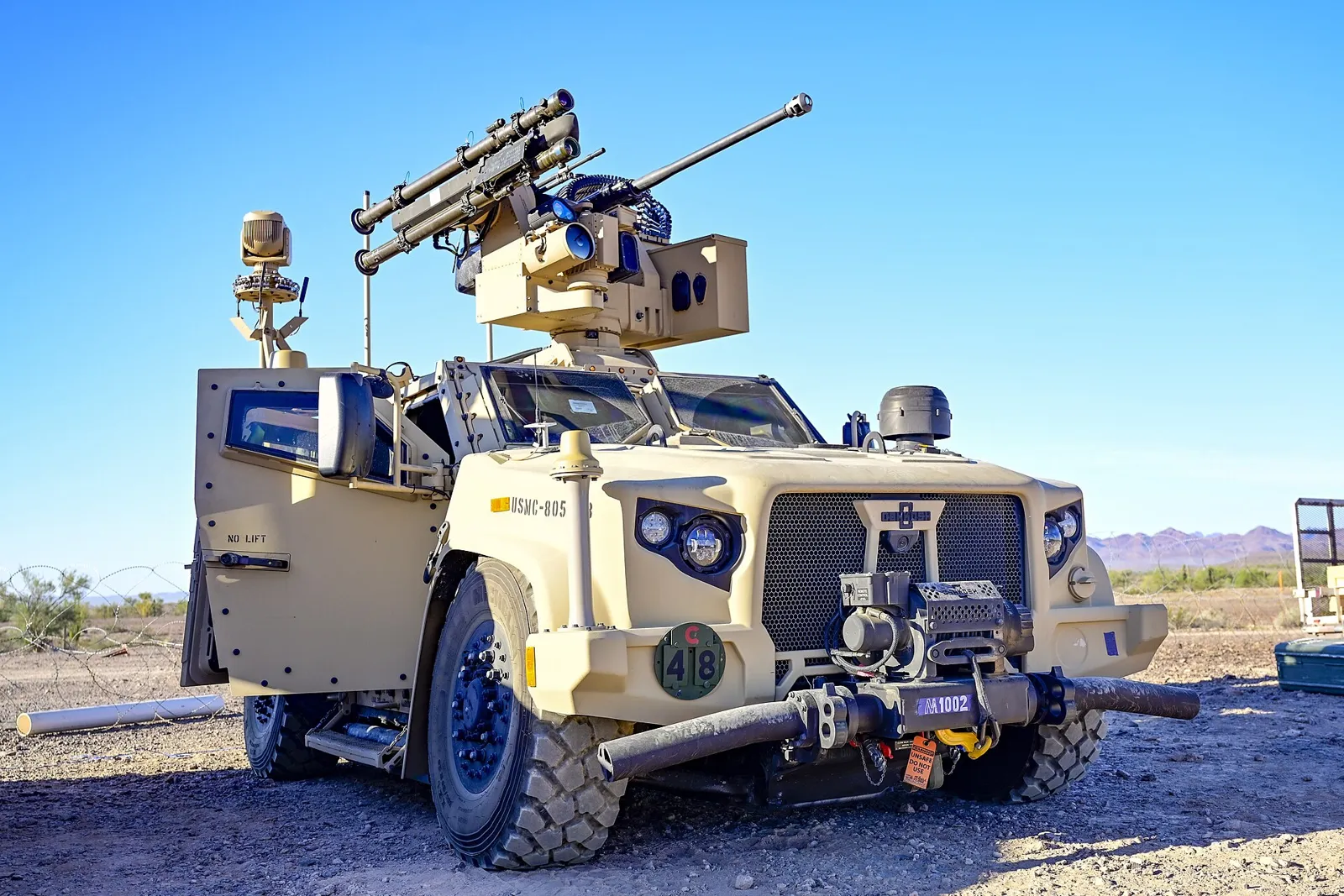
Guns remain important because each round is cheap. The Marine Corps MADIS Mk1 carries a 30mm cannon, and the Army's Maneuver Short-Range Air Defense (M-SHORAD) Stryker combines Stinger missiles and a 30mm cannon, according to CRS. The Navy's experience in the Red Sea, covered below, pushed it toward cheaper options such as aircraft-launched guided rockets.
High-energy lasers offer a very low cost per shot and a deep magazine as long as power and cooling hold out. They also have limits: they engage one target at a time, need to dwell on the target, and lose performance in rain, fog, dust, and smoke. CRS reports that M-SHORAD Increment 2 includes a 50-kilowatt laser for countering Group 1 through 3 UAS.
The Navy has the most public at-sea laser activity. Defense News reported in February 2025, citing the Director, Operational Test and Evaluation annual report, that the Lockheed Martin HELIOS laser, a 60-plus kilowatt system on the destroyer USS Preble, was tested against a drone target in FY2024. The same reporting noted that the Navy had eight Optical Dazzling Interdictor (ODIN) laser dazzlers on Arleigh Burke-class destroyers. A dazzler aims to blind a drone's optical sensors rather than destroy the airframe.
High-power microwave (HPM) weapons are electromagnetic attack in the most literal sense: they push enough RF energy into a drone's electronics to upset or damage them. Their appeal against swarms is a wide beam that can affect several drones at once, with no ammunition to reload. The Air Force Research Laboratory's Tactical High-power Operational Responder (THOR) defeated a drone swarm in an April 2023 test at Kirtland Air Force Base, according to Air & Space Forces Magazine, and a follow-on prototype named Mjolnir is being built by Leidos. The Army received its first Epirus Leonidas prototype under the Indirect Fire Protection Capability High-Power Microwave (IFPC-HPM) effort in late 2023, with three more to follow, according to Defense News.
HPM's range is short compared with interceptors, and its effect depends on how well the target is hardened. Public sources do not provide detailed effectiveness data against military-grade, shielded drones, and none should be assumed.
CRS lists the cost imbalance between drones and countermeasures among its key issues for Congress. The figures cited by Business Insider in 2025 make the point: about $2 million for an SM-2, about $4 million for an SM-6, and roughly $25,000 for an APKWS guided rocket, against Houthi drones costing thousands of dollars. The right C-UAS architecture uses the cheapest effector that will reliably work, saves expensive interceptors for threats that require them, and has enough cheap capacity to absorb a saturation attack.
EA's dominance rests on one assumption: the drone needs a radio link at the critical moment. Two developments in Ukraine are eroding that assumption, and they are the most important trends for anyone designing C-UAS systems today.
A fiber-optic drone carries a spool of thin optical fiber that pays out behind it in flight. Commands go up the fiber and video comes down it, with no RF emission to detect, jam, or take over. Radio Free Europe/Radio Liberty reported in March 2025 that Russia fielded fiber-optic FPV drones first, notably in the Kursk region after Ukraine's summer 2024 incursion, and that Ukraine had since identified viable designs from at least six manufacturers. RFE/RL described an effective range of about 10 kilometers without cable breakage. DroneXL, summarizing reporting from The Guardian, cited cable lengths of 10 to 20 kilometers, a cost roughly double that of a standard FPV, and an estimate that fiber-optic drones made up about 10 percent of Ukrainian drone output from 11 producers.
The trade-offs are real. The spool adds weight and cuts payload, the fiber can snag or break, and pilots need retraining. Ukrainian sources quoted in that coverage said experienced pilots can fly the drones very low and between trees. Countermeasures reported so far are improvised: nets strung between trees, attempts to cut or burn the fiber, and tracing the line back to the operator, with limited success. Public reporting describes them as being used as a first wave of attack because they cannot be jammed.
For C-UAS, the implications are direct:
The second development is onboard autonomy. If the drone can find and track its target with its own camera and processor, jamming the link in the last few hundred meters no longer stops the attack. The Kyiv Post reported in September 2025 that Ukrainian firms Vyriy and The Fourth Law were producing an FPV drone with a terminal guidance module that uses machine vision to take over the final stage of an attack at about 500 meters from the target. The Fourth Law's chief executive claimed the system increased strike effectiveness two to four times while raising cost by only about 10 percent. Those are vendor claims, not independent test results, but the direction is clear.
Autonomy does not make a drone invisible; it still has radar, optical, thermal, and acoustic signatures. What autonomy removes is the defender's ability to win by cutting the link at the last moment. That pushes C-UAS toward earlier detection, earlier engagement while the link is still in use, and hard-kill or directed energy options for the terminal phase.
None of this makes EA obsolete. Most drones in use still rely on radio links and satellite navigation, and jamming remains the cheapest way to defeat them in volume. But EA has moved from being the C-UAS answer to being one layer in a defense that must also work against drones that never emit.
In 2019 the Secretary of Defense named the Army as DoD's executive agent for counter-small UAS, and in 2020 DoD established the Joint Counter-small Unmanned Aircraft Systems Office (JCO) under DoD Directive 3800.01E, according to CRS. The JCO's role was to coordinate doctrine, requirements, materiel, and training across the services. In December 2024, DoD published its Strategy for Countering Unmanned Systems, which CRS says superseded earlier counter-UAS strategies from 2016 and 2020 and broadened the focus from UAS to unmanned systems generally.
On August 28, 2025, Secretary of Defense Pete Hegseth directed the Army to stand up Joint Interagency Task Force 401 (JIATF 401) and disestablish the JCO, according to DefenseScoop. The task force reports to the Deputy Secretary of Defense, consolidates DoD-wide C-sUAS research, development, test, and evaluation outside service-specific and Special Operations Command programs, absorbs Replicator-related counter-drone resources, and gives its director authority to approve up to $50 million per counter-drone effort. Breaking Defense identified the director as Brig. Gen. Matt Ross.
Congress then put the task force into statute. DroneLife's summary of the FY2026 NDAA describes Section 912 as adding a new 10 U.S.C. 199 that establishes JIATF 401, with the director responsible for leading and coordinating all DoD efforts to defeat small unmanned aircraft, integrating C-sUAS solutions across the services, and developing and sharing C-UAS training materials. The same section directs the director to identify differences in how the military departments interpret existing C-UAS authority. Details of the task force's internal structure and budget are not fully public.
As executive agent, the Army fields the largest C-sUAS portfolio. According to CRS:
CRS also notes that the Army planned nine counter-UAS batteries by FY2029.
The Marine Corps has built its C-UAS around expeditionary vehicles. The Marine Air Defense Integrated System (MADIS) uses two Joint Light Tactical Vehicles: per The War Zone, one with a 30mm cannon, M240C machine gun, and Stinger capability, and the other carrying radar and C-UAS equipment. L-MADIS puts a similar capability on two Polaris MRZR light vehicles that can be carried by MV-22 or CH-53; one carries the sensors (a turret, an RPS-42 radar, and Skyview MP passive RF detection), and the other carries the Modi II jammer. In May 2024 The War Zone reported a requirement for 190 MADIS and 21 L-MADIS systems, with fielding starting in early 2025, alongside plans to give individual Marines rifle-mounted counter-drone aids and to protect 34 installations. CRS adds the Installation-Counter Small UAS (I-CsUAS) program, for which Anduril received a $640 million contract in March 2025, and the Medium-Range Intercept Capability.
The Navy's public C-UAS activity is largely shipboard and has been shaped by combat in the Red Sea. Public elements include the DRAKE backpack jammer cited by CRS, the ODIN dazzlers and HELIOS laser described above, and a 150-kilowatt laser weapon system demonstrator on a San Antonio-class ship noted in the Defense News report. CRS records a $14.2 million RDT&E request for the Navy's counter-UAS program in FY2025.
The Air Force's main public C-sUAS efforts are base defense and directed energy. NINJA, described by CRS as using the drone-to-operator radio link to detect, track, locate, identify, and defeat, had been installed at 99 Air Force locations by 2023. THOR and its successor Mjolnir carry the HPM line of effort.
Overseas, C-UAS falls under the law of armed conflict and the rules of engagement. At home, almost every C-UAS action touches a federal criminal statute. A February 2026 CRS Insight lists the Wiretap Act and the Pen/Trap Statute (intercepting or recording communications and signaling data), the Computer Fraud and Abuse Act (accessing a protected computer, which includes taking control of a drone), the Aircraft Sabotage Act and Aircraft Piracy Act (damaging or seizing an aircraft, and drones are aircraft), and laws on interference with communications and satellite operations. Any agency that wants to detect drones by intercepting their signals, jam them, take them over, or knock them down needs specific statutory relief from those laws. Congress has provided it in a few places.
Section 1697 of the FY2017 NDAA created 10 U.S.C. 130i, which lets DoD take action to mitigate UAS threats to covered facilities and assets in the United States. Coverage was first limited to missions such as nuclear deterrence, missile defense, and national security space, and was expanded in 2018 to include missions such as presidential protection, air defense, combat support agencies, special operations, explosives handling, and major range and test facilities, according to CRS. Congress has repeatedly modified and extended the authority's sunset; CRS reported in March 2025 that it was set to expire at the end of 2026, and a separate CRS Insight notes that the FY2025 NDAA did not extend it. Readers relying on it should check the current statutory text, as Congress has continued to amend this area.
The authority is facility-based, and that limitation has been central to the debate over drones near installations. In January 2026, Breaking Defense reported new DoD guidance that lets commanders engage drone threats beyond the fence line with FAA coordination, treats unauthorized surveillance of designated facilities as a threat, lets service secretaries designate which facilities receive protection, and allows tracking and sensor data to be shared with DHS and DOJ. According to DroneLife, the FY2026 NDAA also added an annual public reporting requirement on 130i detection and mitigation events, including whether drones were seized, disabled, or destroyed and whether communications links were intercepted.
The Preventing Emerging Threats Act of 2018 created 6 U.S.C. 124n, giving DHS and DOJ C-UAS authority to protect covered facilities and assets. Per CRS, the authorized actions include detecting, identifying, monitoring, and tracking drones; warning the operator; and disrupting control of, seizing, disabling, damaging, or destroying the drone. The authority was originally limited to four years and has been extended several times; the February 2026 CRS Insight lists its current expiration as September 30, 2031. The Department of Energy also holds limited C-UAS authority, and the FY2026 NDAA added a DOE provision for nuclear facilities.
The largest recent change came in the FY2026 NDAA, signed in December 2025, which included the SAFER SKIES Act. For the first time, eligible state, local, tribal, and territorial law enforcement and correctional agencies can detect and track drones and, in limited circumstances, disable or seize them, subject to federal training, certification, approved equipment lists, and reporting. According to Conventus Law, DOJ and DHS published an interim final rule on July 6, 2026, effective July 1, 2026, with a two-tier training structure: detection certification online, and mitigation training in person at the FBI's National Counter-UAS Training Center. The Federal Communications Commission must authorize RF-emitting C-UAS equipment before it is used, and in July 2026 the FCC announced temporary spectrum authority and related guidance to implement the law.
For spectrum professionals, domestic EA against drones is now a regulated activity carried out by more agencies, with the FCC and NTIA in the loop.
The war in Ukraine is the largest public case study of drones and C-UAS under combat conditions. Several lessons stand out in open reporting.
Beginning in October 2023, Houthi forces in Yemen launched drones and missiles at commercial shipping and US and allied warships in the Red Sea and Gulf of Aden. US warships shot down hundreds of missiles and drones. CRS records that then-Secretary of the Navy Carlos Del Toro said in April 2024 that the Navy had spent about $1 billion in munitions during Middle East operations.
The public lessons focus on cost and adaptability. Then-Chief of Naval Operations Adm. Lisa Franchetti said in October 2024 that the Navy was "using what you have differently," including Hellfire missiles against uncrewed surface vessels and aircraft shooting down drones. In 2025, Adm. Daryl Caudle told the Senate Armed Services Committee that the Navy had faced a "learning curve" and had learned to use more air-to-air assets, which are cheaper than an SM-6 or SM-2, and electromagnetic warfare where possible, according to Business Insider. The same reporting said nearly half of the drone kills during Operation Rough Rider involved APKWS guided rockets, at about $25,000 each.
Adm. James Kilby, then acting CNO, described heavy reliance on SM-3 and SM-6 missiles in high-tempo conflict as unsustainable, according to the same report.
Several things are worth tracking.
The electromagnetic kill chain is still the backbone of counter-UAS: RF sensing finds and identifies many drones, and EA defeats them more cheaply than anything else. What has changed is that the adversary now has practical ways around it. A credible C-UAS design assumes some threats will never emit, plans for terminal autonomy, uses the cheapest effector that works, and puts as much effort into identification as into detection and defeat.
How DoD runs electromagnetic spectrum operations: JP 3-85, the EMS superiority strategy, JEMSO cells, EMBM, service EW units, and GAO's...

How GNSS jamming, spoofing, and meaconing work, what Ukraine, the Baltic, and the Middle East show, and how militaries, regulators, and engineers...

How DoD is building assured PNT: GPS and M-code status per GAO, Army MAPS and DAPS, LEO PNT, eLoran, magnetic, vision, quantum sensing, and...