
GPS Jamming and Spoofing: How Modern Conflicts Degrade PNT
How GNSS jamming, spoofing, and meaconing work, what Ukraine, the Baltic, and the Middle East show, and how militaries, regulators, and engineers...
Every modern military capability depends on the electromagnetic spectrum. Radios, data links, radars, satellite terminals, GPS receivers, identification systems, precision weapons, and the sensors that cue them all transmit, receive, or do both. For most of the Cold War and the years after it, the Department of Defense treated two parts of that problem separately. Electronic warfare (as it was then called) belonged to operators and planners focused on jamming and detecting the enemy. Spectrum management belonged to communicators and frequency managers focused on making sure friendly systems could get an assignment and not interfere with each other.
Those two communities are now supposed to work as one. The current doctrinal term is electromagnetic spectrum operations, or EMSO, and at the joint level it is joint electromagnetic spectrum operations, or JEMSO. Since 2020 the department has rewritten its joint doctrine, issued a new superiority strategy, signed a classified implementation plan, stood up a new joint center under U.S. Strategic Command, and started fielding a joint battle management tool for the spectrum. Congress has written much of this into law. The Government Accountability Office has spent more than a decade documenting how hard it is to make any of it stick.
This article walks through what EMSO and JEMSO mean, how the doctrine and terminology evolved, how each service organizes for the mission, what electromagnetic battle management is supposed to do, and where the public record says the effort still falls short. Everything here comes from public, unclassified sources. Where details of plans, capabilities, or readiness are classified or simply not published, that is stated plainly.
Joint doctrine defines EMSO in terms of four verbs: coordinated military actions to exploit, attack, protect, and manage the electromagnetic environment. The first three map to the traditional pieces of electromagnetic warfare. The fourth is spectrum management. Putting all four under one heading is the whole point of the concept. A commander does not get to treat jamming plans and frequency plans as unrelated staff products, because a friendly jammer and a friendly radio net competing for the same band is a planning failure, not bad luck.
JEMSO is the same idea applied to a joint force. Joint Publication 3-85, Joint Electromagnetic Spectrum Operations, describes JEMSO as the electromagnetic warfare and joint spectrum management activities a joint force commander uses to exploit, attack, protect, and manage the electromagnetic operational environment in pursuit of the commander's objectives. The emphasis on the joint force commander matters. Each service brings its own emitters, sensors, and EW systems into a theater, and someone above the services has to decide who gets which frequencies, which emitters are restricted, and when offensive effects can be used without blinding friendly forces.
Doctrine uses the term electromagnetic operational environment (EMOE) for the conditions a force actually faces in a given area and time: friendly, adversary, neutral, and civilian emitters, plus natural phenomena. In a contested region that includes adversary jammers and direction-finding sensors hunting for friendly emissions. Building an accurate picture of that environment is one of the hardest parts of the job.
Electromagnetic warfare (EW) is military action involving the use of electromagnetic and directed energy to control the spectrum or to attack an enemy. It has three divisions:
Readers who learned the field before 2020 will remember these as electronic attack, electronic protection, and electronic warfare support. The functions did not change. The names did, and the reason is covered below.
The fourth verb, manage, covers the planning, coordination, and deconfliction of spectrum use so that friendly systems can operate as intended. That includes frequency assignment and allotment, host nation coordination, interference resolution, and the creation and maintenance of the Joint Restricted Frequency List (JRFL), which identifies frequencies that must be protected from friendly EA, such as critical command nets or frequencies being exploited for intelligence. Joint doctrine now uses the phrase joint electromagnetic spectrum management operations for this work at the joint level.
The current framework is relatively young. Understanding what it replaced explains a lot about why implementation has been slow.
Until 2020, joint doctrine covered the two halves of the problem in separate publications. JP 3-13.1, titled Electronic Warfare, was last revised in 2012 and sat in the 3-13 information operations family. JP 6-01, Joint Electromagnetic Spectrum Management Operations, also dated 2012, sat in the communications family. Different staff sections owned each one. EW cells generally lived in operations or information operations channels. Spectrum managers generally lived in the J-6. The two communities trained separately, used different tools, and often met for the first time in a theater when something interfered with something else.
Strategy followed a similar split. DoD issued an Electromagnetic Spectrum Strategy in 2013 and an Electronic Warfare Strategy in 2017. GAO later found that neither was fully implemented. Of 23 recommendations derived from the 2013 strategy, GAO reported that only three had been completed by January 2019, more than five years after publication.
The operational context pushed in the same direction. Russian operations in Ukraine after 2014 and in Syria after 2015 showed adversary EW jamming communications and GPS and locating emitters for targeting. GAO's 2020 report cited Defense Intelligence Agency characterizations of Russian EW as world-class. Two decades in Iraq and Afghanistan, focused on countering radio-controlled IEDs, had left the U.S. force less practiced at fighting for spectrum access against a peer.
On 22 May 2020, the Joint Staff published JP 3-85, Joint Electromagnetic Spectrum Operations. It superseded both JP 3-13.1 and JP 6-01 and consolidated EW and spectrum management into one joint publication. Defense press at the time noted the conceptual shift: the publication treats the spectrum as a maneuver space in which the joint force must gain and keep freedom of action, not simply as a utility to be allocated.
The key changes, at the level that is publicly described, were these:
The services aligned their own doctrine after the joint publication. The Air Force, for example, redesignated its EW and EMSO doctrine from AFDP 3-51 to AFDP 3-85 to match the joint numbering. The Army's 2021 revision of FM 3-12 carried the title Cyberspace Operations and Electromagnetic Warfare, replacing the 2017 version that used "electronic warfare" in its title.
The change from electronic warfare to electromagnetic warfare sounds cosmetic, and in part it is. The functions, the acronyms, and most of the definitions survived. The argument for the change is that "electronic" describes the equipment, while "electromagnetic" describes the medium in which the fight happens. Directed energy, infrared and optical systems, and the spectrum as a whole sit more naturally under the broader term. It also aligns the vocabulary of EW with the spectrum-wide framing of EMSO: electromagnetic attack, electromagnetic protection, and electromagnetic support all live inside electromagnetic spectrum operations.
In practice, the older terms persist in unit names, system names, contract titles, older publications, and in the way many practitioners talk. The Air Force's 53rd Electronic Warfare Group, for example, kept its name when it moved under a new wing in 2021. When reading older documents, treat "electronic attack," "electronic protection," and "electronic warfare support" as the predecessors of today's EA, EP, and ES. When writing new material, use the current terms.
In October 2020, DoD released its Electromagnetic Spectrum Superiority Strategy. It replaced the separate spectrum and EW strategies with a single document covering the whole mission area. The public version set five goals:
The strategy stated that U.S. dominance across the domains and the spectrum was being challenged by peer and near-peer adversaries. It also leaned on technology themes that recur throughout the mission area: dynamic spectrum sharing, frequency agility, modular and software-defined systems, and less dependence on platform-specific solutions.
The strategy called for an implementation plan within 180 days, which put the target at roughly March 2021. The plan arrived later. Secretary of Defense Lloyd Austin signed it on 15 July 2021, and it was announced the following month. The plan itself is classified. What the department said about it publicly includes the following:
Officials described the plan as the first unified department-level approach to EW and spectrum operations.
Congress has repeatedly legislated in this area, and the result is now a cluster of provisions in Title 10 of the U.S. Code, sections 500a through 500f. Among other things, these provisions:
The EMSO concept joins spectrum management and EW, but it does not erase the differences between them. They have different purposes, different legal and policy frameworks, and different workforces. Planners who understand both sides can avoid most of the friction that shows up in exercises.
| Aspect | Spectrum management | Electromagnetic warfare |
|---|---|---|
| Primary purpose | Enable friendly spectrum use without harmful interference | Gain advantage by exploiting, attacking, and protecting in the spectrum |
| Typical outputs | Frequency assignments, allotment plans, host nation coordination, interference resolution, JRFL inputs | EA target lists and timing, ES tasking and reporting, EP measures, EW reprogramming |
| Governing framework | National and international spectrum regulation (NTIA for federal users in the U.S., host nation authorities and international agreements abroad) plus DoD policy | Operational authorities from the joint force commander, rules of engagement, and coordination with intelligence authorities for ES |
| Traditional staff home | J-6 / S-6 communications sections | J-3 / S-3 operations, EW cells, or cyber and EW sections |
| Main risk if neglected | Friendly fratricide in the spectrum, denied host nation access, systems that cannot be used where they are deployed | Loss of initiative to an adversary that controls the spectrum, exposed friendly emitters |
The interaction points are where most problems arise. A friendly EA mission can jam friendly communications if the JRFL is incomplete or not respected. Friendly emitters that are poorly managed create signatures that adversary ES can locate and target. Spectrum managers working peacetime assignment processes may not have the tools or authorities to support a fast-moving fight, while EW planners may not understand the regulatory constraints that limit what can be transmitted in training or in a host nation. JEMSO is meant to put those decisions in one process under one commander.
Doctrine and strategy matter little without staff structures that can actually plan and direct EMSO. Joint doctrine and recent organizational changes address this at two levels: within a joint force headquarters, and at the enterprise level.
JP 3-85 describes a joint electromagnetic spectrum operations cell, abbreviated JEMSOC and commonly called a JEMSO cell, as the staff organization that plans, coordinates, and assesses JEMSO for the joint force commander. In the older model, a joint force might have had a joint EW cell in operations and a joint spectrum management element in communications. The JEMSO cell combines those functions. Publicly available descriptions of JEMSO cell work include:
Doctrine also provides for an EMS coordinating authority, a role the joint force commander can assign so that one official coordinates spectrum activities across components day to day. Training material based on JP 3-85 describes combatant commanders and joint force commanders establishing a JEMSOC to support planning, coordination, and control of the spectrum, with the JEMSOC director typically serving as that coordinating authority. The details of how a given command structures these elements vary with the operation and the commander's choices, and the most specific guidance sits in the full doctrine and in classified plans.
At the enterprise level, the implementation plan's call for a STRATCOM-led center produced the Joint Electromagnetic Spectrum Operations Center (JEC). STRATCOM began standing it up in 2021 and formally established it in July 2023, with its headquarters at Offutt Air Force Base, Nebraska. At establishment, the JEC brought together:
The JEC's stated mission is to raise joint force readiness in the spectrum by providing operational leadership, assessing readiness, and standardizing EMSO cells across the combatant commands. Its first commander, then-Brig. Gen. AnnMarie Anthony, said it reached initial operating capability in summer 2023 and expected full operating capability in fiscal 2025. Whether it reached that milestone on schedule, and what readiness assessments it has produced, are not detailed in the public record. Those assessments are largely classified.
Electromagnetic battle management (EMBM) is the dynamic monitoring, assessing, planning, and directing of JEMSO in support of the commander's scheme of maneuver. Put simply, it is the function that lets a commander see what is happening in the spectrum, decide what to do about it, and push those decisions to the forces fast enough to matter.
Traditional spectrum management works on timelines of days to months. Frequency requests go through approval chains, assignments go into databases, and plans get published. EW planning in the targeting cycle often runs on the air tasking order cycle or similar. Neither is fast enough when an adversary is changing frequencies, moving jammers, and hunting friendly emitters in minutes. EMBM is the attempt to close that gap with:
Each of those depends on data the department has historically kept in separate systems, at different classification levels, in formats that do not interoperate. GAO's 2024 review of spectrum IT listed the DoD systems in this space, including the Global Electromagnetic Spectrum Information System (GEMSIS), the Joint Spectrum Data Repository, Spectrum XXI, the End-to-End Supportability System, Joint Spectrum Interference Resolution Online, and an EMBM tool, among others. Spectrum XXI is used across the government. GAO noted that DoD had contracted for an analysis of its spectrum IT, planned to migrate systems to the cloud, and had paused modifications to Spectrum XXI during that migration.
The joint program is Electromagnetic Battle Management-Joint (EMBM-J), with DISA as developer and STRATCOM as the operational partner. DISA released a first minimum viable capability in December 2023. As publicly described, it is a cloud-based application giving combatant commands and joint task force JEMSO cells a unified visual display of the EMS battlespace, using a common data layer intended to interoperate with service tools such as the Army's Electromagnetic Warfare Planning and Management Tool. DISA's spectrum program executive office described it as a way to give commanders a visualized EMS common operating picture so they can act quickly.
In April 2024, DISA awarded Palantir a 12-month, $9.8 million agreement to prototype an EMBM-J decision support capability at Impact Level 6, focused on mission analysis, course of action development, wargaming, and product generation. The pattern, a minimum viable product followed by incremental capability releases and a separate decision support prototype, is typical of current software acquisition approaches.
What is not public is how well EMBM-J performs in exercises, how many commands use it operationally, or how much of the planned functionality has been delivered.
Each service organizes, trains, and equips its own EMSO forces, and their approaches reflect different histories and missions. The descriptions below cover what is publicly documented. Force structure numbers and specific capability details are often not published.
The Army largely divested its tactical EW capacity after the Cold War and spent the years in Iraq and Afghanistan focused on countering radio-controlled IEDs. It has been rebuilding since. EW officers and soldiers now sit in the Army's cyber branch, and the service uses the label cyberspace electromagnetic activities (CEMA) for the staff function that integrates cyber operations, EW, and spectrum management. CEMA sections at brigade and higher bring together EW personnel and spectrum managers, the latter drawn from the signal community.
Key public elements include:
The Navy has the longest continuous investment in airborne and shipboard EW among the services. Its EMSO forces include:
The Air Force made the most visible organizational move after the 2020 strategy. On 25 June 2021, Air Combat Command activated the 350th Spectrum Warfare Wing, initially at Eglin Air Force Base, Florida, pending a permanent basing decision. The wing was created to address atrophy in EW expertise and to give the service a single organization focused on EMS capability for the combat air forces. Its first commander, Col. William Young, said at activation that if the force loses the fight in the EMS, it will lose the fights in all other domains.
The wing's core missions include EW reprogramming and mission data, the work of updating threat libraries and system software so that aircraft EW systems and sensors recognize and respond correctly to the emitters they will face. That work matters for every modern combat aircraft, including the F-35, whose mission data files tell its sensors what they are seeing. The 53rd Electronic Warfare Group (a unit name that predates the terminology change) moved from the 53rd Wing into the new wing. Its subordinate structure includes spectrum warfare groups, with the 350th and 850th Spectrum Warfare Groups activated with the wing and a 950th Spectrum Warfare Group added in 2024.
Beyond the wing, Air Force EMSO capabilities include the EC-37B Compass Call, which is replacing the EC-130H as the service's airborne communications EA platform, self-protection EW suites on combat aircraft, and ES contributions from ISR platforms. The Air Force redesignated its EMSO doctrine as AFDP 3-85 to match the joint publication.
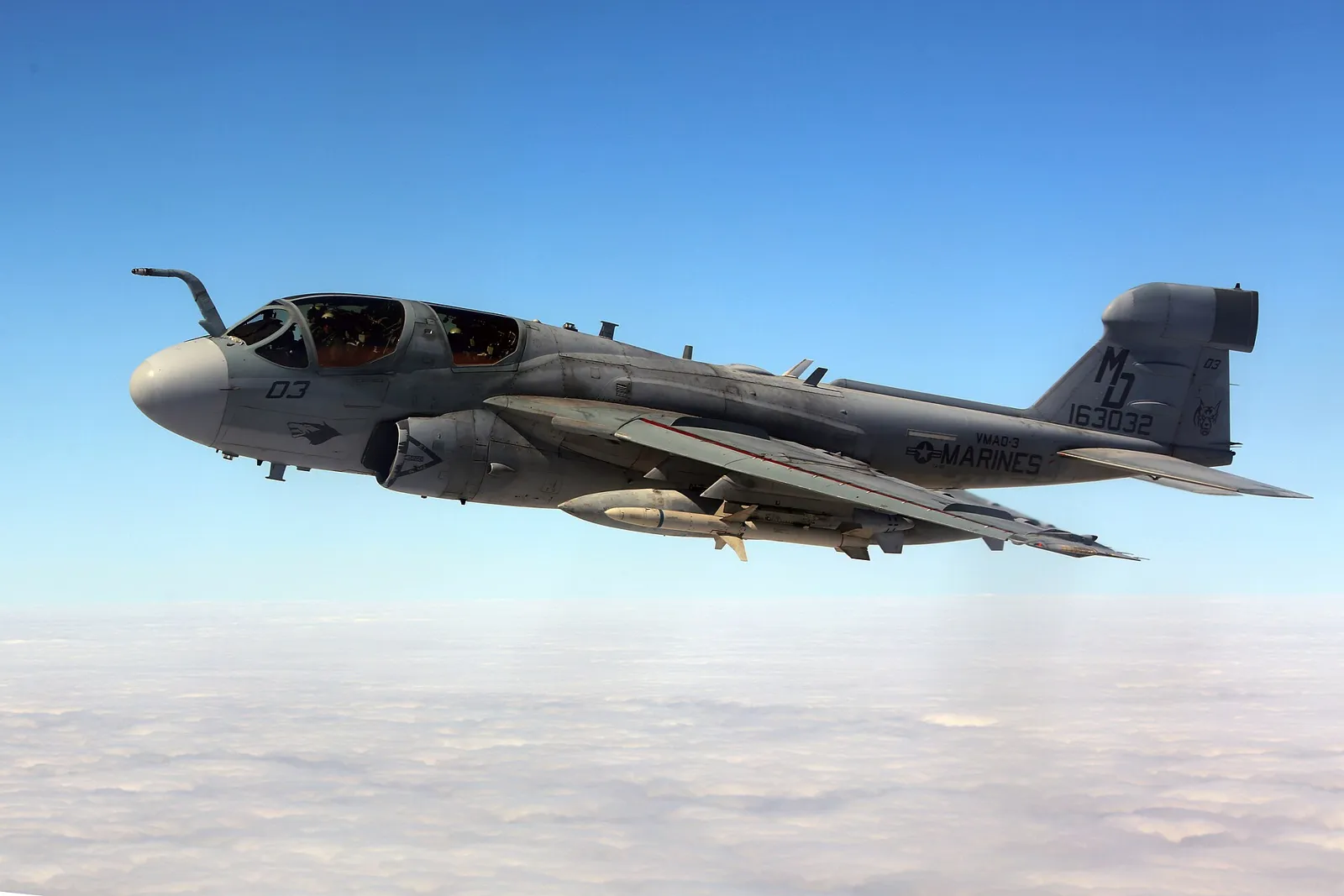
The Marine Corps retired its EA-6B Prowlers in 2019, ending its dedicated tactical jamming aircraft, and shifted toward a distributed approach built on its information warfare organizations and on EW payloads carried by multiple platforms. Key public elements include:
Marine officials have emphasized ES as something the Marine Corps can provide to the naval and joint force during competition, not only in conflict. That fits the stand-in force concept, in which small Marine units operating inside an adversary's weapons engagement zone collect and pass information while managing their own signatures carefully. For these units, emission control is a survival requirement. The Corps has continued to adjust its EW organization since Force Design began, and public detail on newer EW-focused organizations is limited.
GAO's December 2020 report, GAO-21-64, remains the most comprehensive public assessment of EMS superiority governance. Its main findings were:
GAO made recommendations covering integration processes, governance reform, senior leadership assignment, and oversight and accountability. DoD concurred with some and partially concurred with others, pointing to pending organizational decisions. In March 2021 testimony, GAO's director for defense capabilities and management warned that the United States risks losing control of the battlefield if it does not control the spectrum, and that the 2020 strategy faced the same risk of non-implementation as its predecessors.
Since then, the implementation plan was signed, DoD CIO took over oversight, the JEC was established, and Congress codified an EMSO Executive Committee and an operational lead at STRATCOM. Those steps respond directly to GAO's concerns. Whether they have produced measurable improvement in readiness is harder to judge from public sources, because readiness assessments and the implementation plan's metrics are classified. The statutory annual reporting requirements running through fiscal 2029 are the best indicator that Congress intends to keep asking.
Workforce problems show up across nearly every assessment of the mission area. GAO identified insufficient expertise and training deficiencies in 2020. The underlying causes are well known to practitioners:
New organizations such as the 350th Spectrum Warfare Wing, the Army's expanded CEMA force, and the JEC respond to these problems. Public metrics on whether they have closed the gap are not available.
The spectrum DoD needs is also prime commercial real estate. Mid-band frequencies in particular are valuable for 5G and future 6G networks, and several of those bands host important military systems. The policy fight over the lower 3 GHz band (3.1 to 3.45 GHz) illustrates the tension.
The department operates many radar systems in that band, including systems used for missile defense, airborne early warning, air surveillance, and counterfire. Defense officials testified that relocating some of those systems could take decades and cost enormous sums. For one system, the Aegis radar, a DoD official put the cost of replacement at about $120 billion over roughly two decades. DoD's Emerging Mid-Band Radar Spectrum Sharing (EMBRSS) assessment, completed in 2023 and released in redacted form in April 2024, concluded that sharing the lower 3 GHz band was not feasible unless specific conditions were met, including DoD retaining primary use of the band and meeting particular security requirements, with dynamic sharing possible only in a limited form.
Congress addressed the question in the reconciliation law signed on 4 July 2025. That law restored the FCC's general spectrum auction authority through September 2034 and established a pipeline of at least 800 megahertz for commercial auction, with deadlines for NTIA to identify federal spectrum and for the FCC to complete auction tranches. It explicitly excluded the 3.1 to 3.45 GHz band and the 7.4 to 8.4 GHz band, the latter used for military X-band satellite communications, from the bands that could be identified for auction. Those exclusions protect two major DoD equities, but the pipeline still requires substantial federal spectrum to be identified elsewhere, and some of that will come from bands federal users currently occupy.
The process for making those decisions is itself a subject of oversight. In June 2026, GAO reported (GAO-26-107873) that DoD generally follows leading collaboration practices for its internal frequency coordination, and that the EMBRSS working group met most or all aspects of several leading practices. GAO also found that DoD did not clearly tell nonfederal participants whether and how their input would be used in the EMBRSS study, and that DoD and NTIA lacked documented processes for a 2024 study of the 37 GHz band. GAO recommended that DoD CIO document how stakeholder input is evaluated and that DoD and NTIA establish written approaches for future repurposing studies. Both agencies agreed.
The direction in law and policy is more sharing and more dynamic access. Title 10 now requires the STRATCOM operational lead to evaluate tactics and procedures for dynamic spectrum sharing. Systems designed around exclusive access to a fixed band will face growing pressure.
DoD's spectrum IT has accumulated over decades in separate systems, and GAO's 2024 report showed modernization still in the planning stage. Moving data between unclassified spectrum databases and classified threat and EW data remains a practical obstacle for EMBM. GAO has also pointed to long acquisition timelines for EW systems facing threats that change quickly. The Army's middle-tier approach to TLS and DISA's incremental releases of EMBM-J are attempts to shorten that cycle.
The EMSO enterprise has a clearer structure than it did in 2020: one joint publication, one strategy, an implementation plan, a designated oversight official, a joint center, a joint battle management program, and statutory reporting requirements. The open questions are about execution. Indicators worth tracking in the public record include:
The argument behind EMSO is widely accepted: a joint force that cannot see, use, and control the spectrum will struggle to do anything else. Since 2020 the department has built the doctrine, organizations, and programs to act on it. The public evidence shows real structural progress alongside persistent gaps in workforce, tools, and measurable readiness, with commercial demand for spectrum adding pressure from a different direction.
How GNSS jamming, spoofing, and meaconing work, what Ukraine, the Baltic, and the Middle East show, and how militaries, regulators, and engineers...

How DoD is building assured PNT: GPS and M-code status per GAO, Army MAPS and DAPS, LEO PNT, eLoran, magnetic, vision, quantum sensing, and...
How counter-UAS works from detection to defeat, why jamming is losing ground to fiber-optic and autonomous drones, and who has domestic legal...